This study was conducted with Dong Hun Lee and the co-corresponding authors listed below.
- Daehee Hwang
- Department of Biological Sciences, Seoul National University, Seoul, Republic of Korea
- Dong Hun Lee / EASI Lab PI
- Department of Dermatology, Seoul National University College of Medicine, Seoul, Republic of Korea
- Institute of Human-Environment Interface Biology, Medical Research Center, Seoul National University, Seoul, Republic of Korea
- Jin Ho Chung
- Department of Dermatology, Seoul National University College of Medicine, Seoul, Republic of Korea
- Department of Biomedical Sciences, Seoul National University Graduate School, Seoul, Republic of Korea
- Institute of Human-Environment Interface Biology, Medical Research Center, Seoul National University, Seoul, Republic of Korea
- Institute on Aging, Seoul National University, Seoul, Republic of Korea
Names and affiliations are as published in the article.
The question
Which genes and cellular changes connect reduced HDAC4 to stress-induced senescence in skin fibroblasts?
How we tested it
RNA-seq after HDAC4 overexpression or knockdown in primary human dermal fibroblasts was integrated with public UV- and oxidative-stress senescence datasets. DDIT4 perturbation tested effects on SA-β-gal, SASP and aging-related expression, complemented by analyses of young and aged human skin.
This collaborative study combined newly generated HDAC4-perturbation RNA-seq (GSE181329) and experiments with public senescence transcriptomes (GSE60795 and GSE116761).
What the study found
DDIT4 knockdown reduced the senescence-modulating effect of HDAC4, while DDIT4 overexpression improved several senescence-associated readouts. Lower DDIT4 expression in aged human skin provided tissue-level support for further investigation of the HDAC4–DDIT4 pathway.
Interpreting the evidence
The evidence comes from cell models and comparisons of human skin across age groups. It does not establish clinical rejuvenation, and the precise mechanism linking HDAC4 to DDIT4 expression remains to be resolved.
Figures from the paper
Figure 2A–B shows integrative candidate selection; Figure 6A shows DDIT4 immunohistochemistry in human skin. The gene-perturbation experiments are not shown in these images.
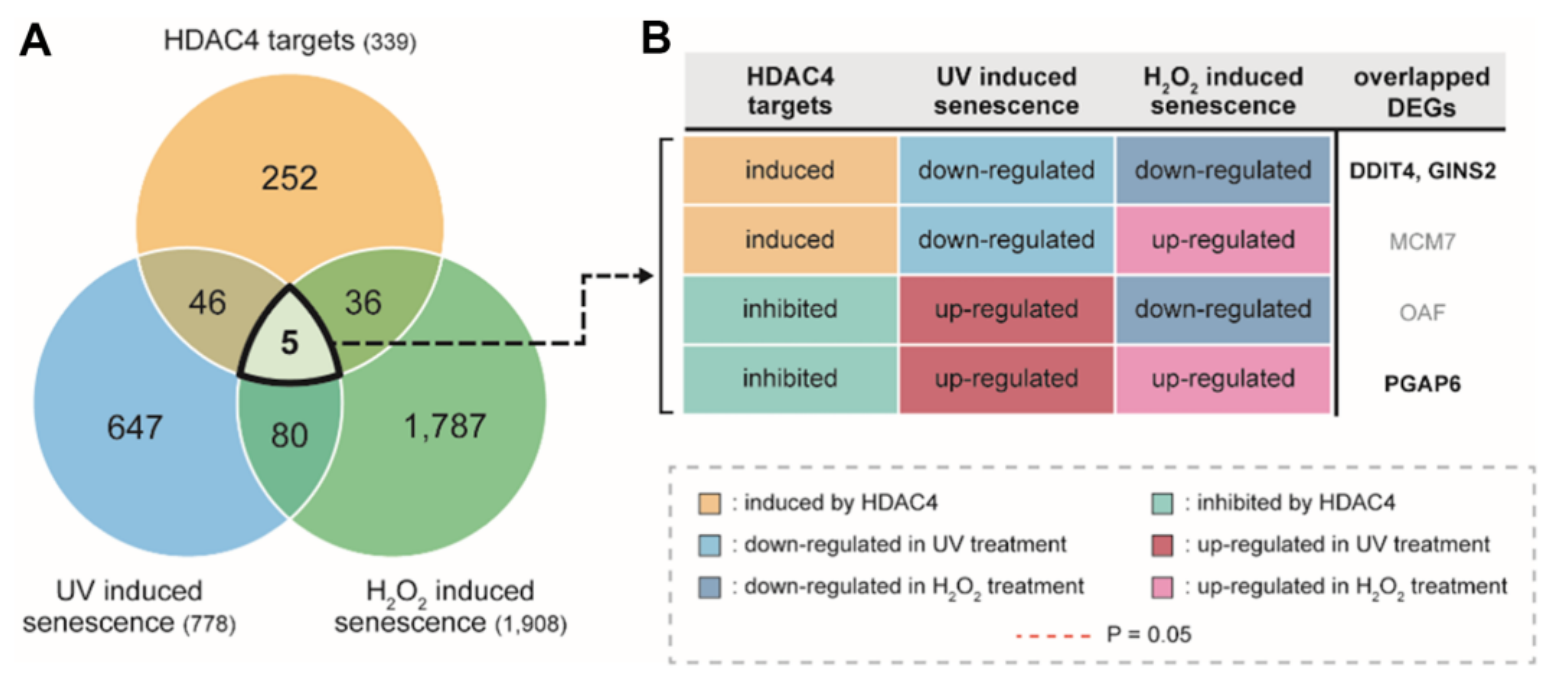
Transcriptomes from HDAC4 perturbation and two senescence models narrow the candidate set. Follow-up gene perturbation experiments in the paper test the role of DDIT4.
CC BY 3.0 · Publication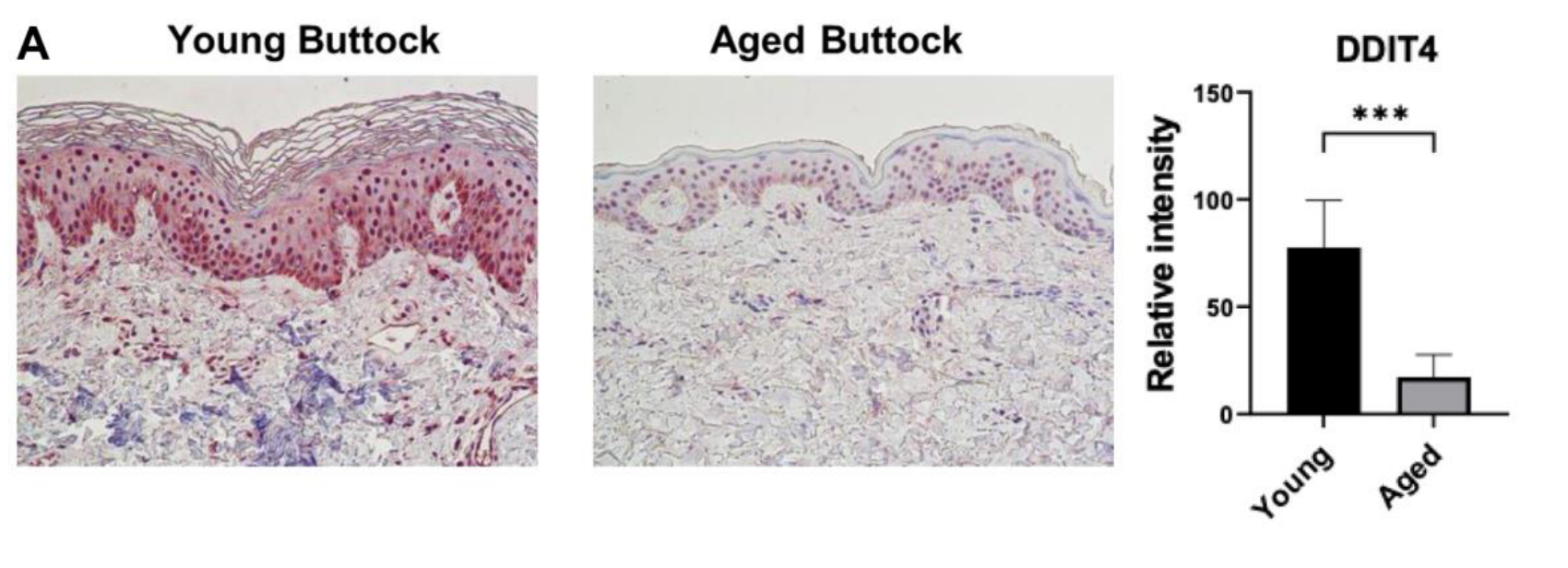
DDIT4 immunohistochemistry and quantification in young and aged human skin, from our study of HDAC4–DDIT4 regulation.
CC BY 3.0 · PublicationA question to explore together
How does the HDAC4–DDIT4 response vary with donor age and UV history, and can the effect be validated at the tissue level?
Discuss this question Explore collaboration topics