This study was conducted with Dong Hun Lee and the co-corresponding authors listed below.
- Jin Ho Chung
- Department of Biomedical Sciences, Seoul National University Graduate School, Seoul, Republic of Korea
- Laboratory of Cutaneous Aging Research, Biomedical Research Institute, Seoul National University Hospital, Seoul, Republic of Korea
- Institute of Human-Environmental Interface Biology, Medical Research Center, Seoul National University, Seoul, Republic of Korea
- Department of Dermatology, Seoul National University Hospital, Seoul National University College of Medicine, Seoul, Republic of Korea
- Institute on Aging, Seoul National University, Seoul, Republic of Korea
- Yong-Seok Lee
- Department of Biomedical Sciences, Seoul National University Graduate School, Seoul, Republic of Korea
- Department of Physiology, Seoul National University College of Medicine, Seoul, Republic of Korea
- Neuroscience Research Institute, Seoul National University College of Medicine, Seoul, Republic of Korea
- Wide River Institute of Immunology, Seoul National University, Hongcheon, Republic of Korea
- Dong Hun Lee / EASI Lab PI
- Laboratory of Cutaneous Aging Research, Biomedical Research Institute, Seoul National University Hospital, Seoul, Republic of Korea
- Institute of Human-Environmental Interface Biology, Medical Research Center, Seoul National University, Seoul, Republic of Korea
- Department of Dermatology, Seoul National University Hospital, Seoul National University College of Medicine, Seoul, Republic of Korea
Names and affiliations are as published in the article.
The question
Which signals connect repeated UV exposure of the skin with changes in brain function?
How we tested it
In a mouse model of chronic skin UV exposure, LC–MS measured dopamine in peripheral tissues and brain regions. Behavioral memory tests, hippocampal electrophysiology, immunofluorescence and RNA-seq were combined with dopamine administration and D1/D5 receptor antagonism.
This multidisciplinary collaborative study integrated measurements and RNA-seq generated in mouse experiments, connecting dermatology, physiology, genomics and analytical expertise.
What the study found
UV exposure was associated with poorer memory performance and reduced hippocampal synaptic plasticity and neurogenesis-related readouts. D1/D5 receptor antagonism supported reversal of these changes. Dopamine increased in skin, adrenal glands and selected brain regions.
Interpreting the evidence
These findings were obtained under specific exposure conditions in female mice and do not establish cognitive effects or treatment efficacy in humans. Increased hippocampal dopamine was not detected, and the precise route connecting skin exposure to brain changes remains unresolved.
Figures from the paper
Figure 1h shows hippocampal DCX and Ki-67/DAPI immunofluorescence in control and UV-exposed mice. Scale bar: 150 μm. It does not directly show dopamine measurements or receptor-antagonism results.
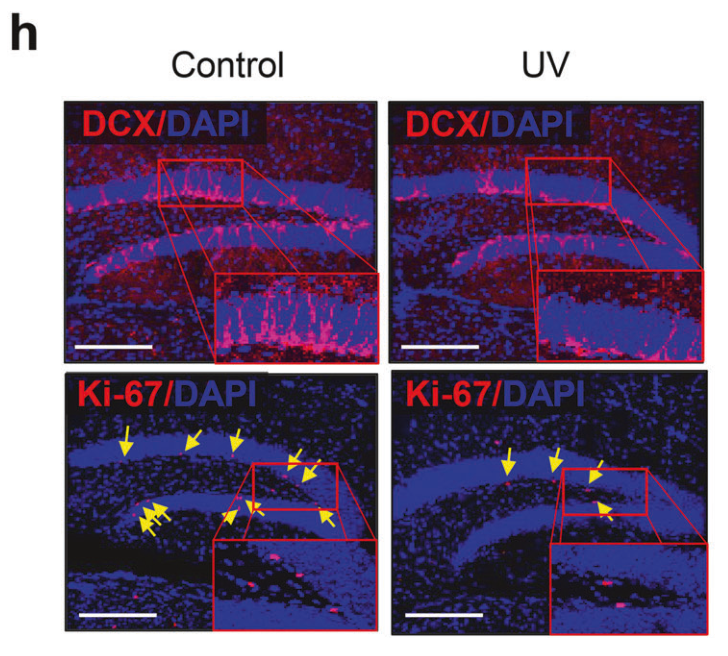
LC–MS, receptor antagonism, behavioral tests and electrophysiology investigate links between skin UV exposure and memory. Shown here: hippocampal immunofluorescence.
CC BY 4.0 · PublicationA question to explore together
Can separating local skin responses from systemic mediators clarify the pathways of UV-associated skin–brain interaction?
Discuss this question Explore collaboration topics